Justice Journeys
Our latest piece of research “Rules for Them and Rules for Us” maps the real-life stories of participants against the complexities of the Scottish justice system.
Alongside “Rules for Them and Rules for Us”, we have created a series of illustrations which map four different #JusticeJourneys: Community Payback Order (CPO), Diversion, Long-term prison sentence and Short-term prison sentence.
We hope that these illustrations will help bring greater understanding of the complexities those involved with the justice system face.
Community Payback Order
A Community Payback Order (CPO) is a court-issued sentence that can include various requirements. Evidence indicates that community interventions can be more effective at reducing reoffending and assisting with rehabilitation than short-term prison sentences.
Step-by-step: Community Payback Order
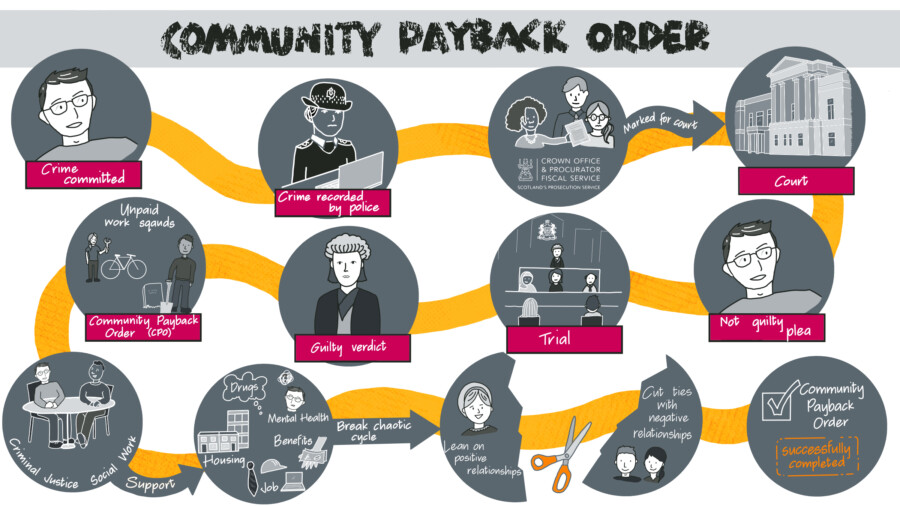
An example Community Payback Order process
Steps in image:
- Crime committed
- Crime recorded by police
- Marked for court/Court
- Not guilty plea
- Trial
- Guilty verdict
- Community Payback Order (CPO)
Diversion from Prosecution
Diversion from prosecution is a process by which the Crown Office and Procurator Fiscal Service (COPFS) are able to refer a case to social work – and their partners – as a means of addressing the underlying causes of alleged offending when this is deemed the most appropriate course of action.
Step-by-step: Diversion from Prosecution
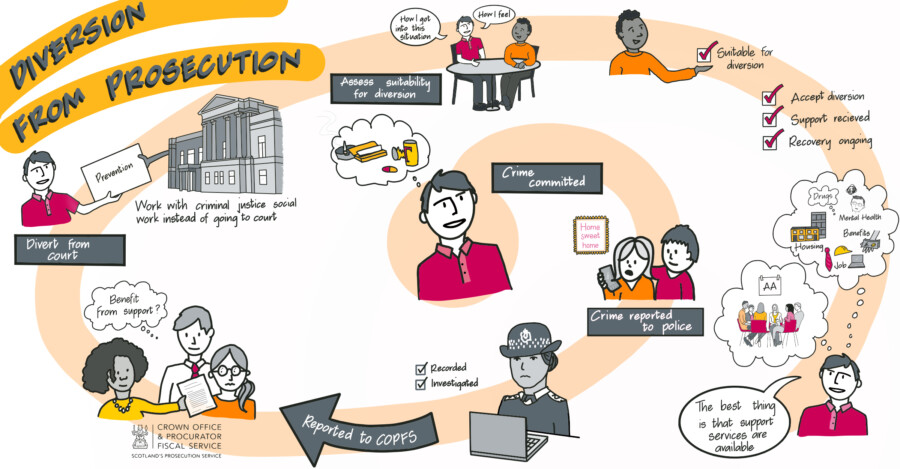
An example Diversion from Prosecution process
Steps in image:
- Crime committed
- Crime reported to police
- Reported to Crown Office and Procurator Fiscal (COPFS)
- Divert from court
- Assess suitability for diversion
- Suitable for diversion
Short-term prison sentence
A custodial sentence of up to 4 years is regarded as a short-term prison sentence.
Step-by-step: short-term prison sentence
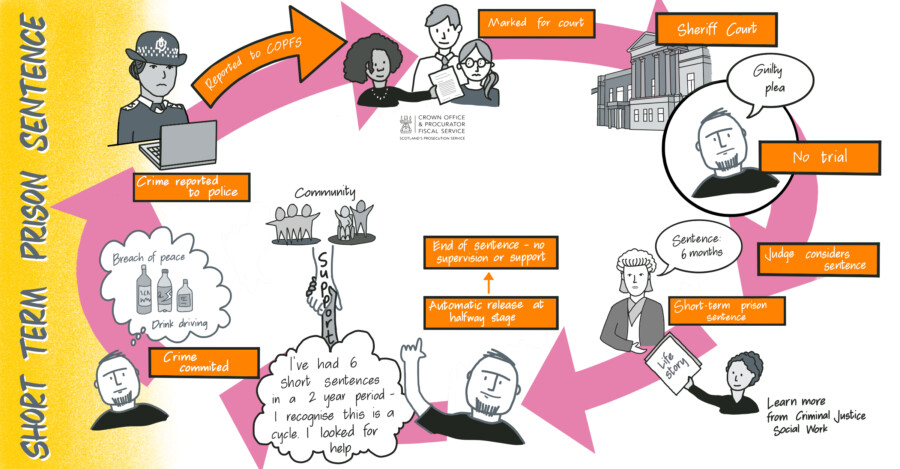
An example short-term prison sentence process
Steps in image:
- Crime committed
- Crime reported to police
- Reported to Crown Office and Procurator Fiscal (COPFS)
- Marked for court
- Sheriff Court
- Guilty plea
- Judge considers sentence
- Short-term prison sentence
- End of sentence/Automatic release at halfway stage – no supervision or support
Long-term prison sentence
A custodial sentence of 4 years or more is regarded as a long-term prison sentence.
Step-by-step: Long-term prison sentence
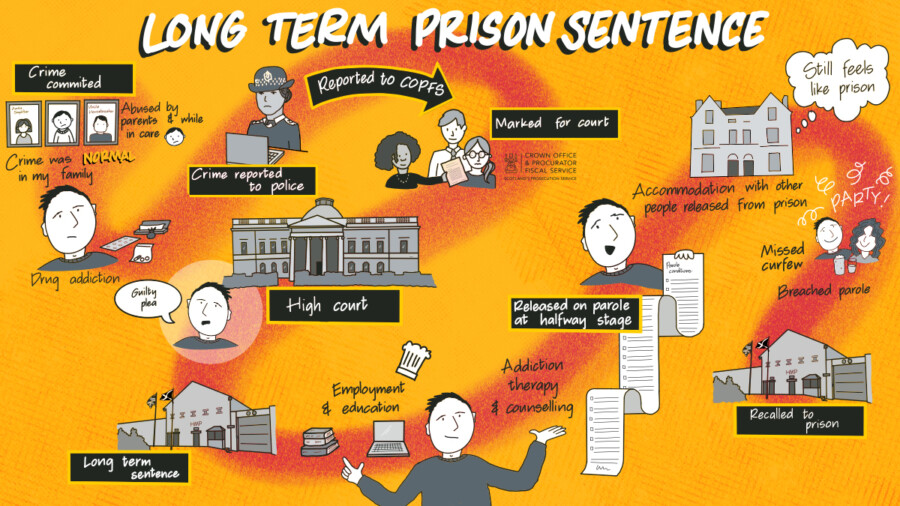
An example long-term prison sentence process
Steps in image:
- Crime committed
- Crime reported to police
- Reported to Crown Office and Procurator Fiscal (COPFS)
- Marked for court
- High Court
- Guilty plea
- Long term prison sentence
- Person receives education, addiction therapy and help with employment
- Released on parole at halfway stage
- Accommodation with other people released from prison
- Breached parole
- Recalled to prison
A victim’s journey
Created in association with Victim Support Scotland, this illustration is adapted from a real victim’s story.
Step-by-step: A victim’s journey
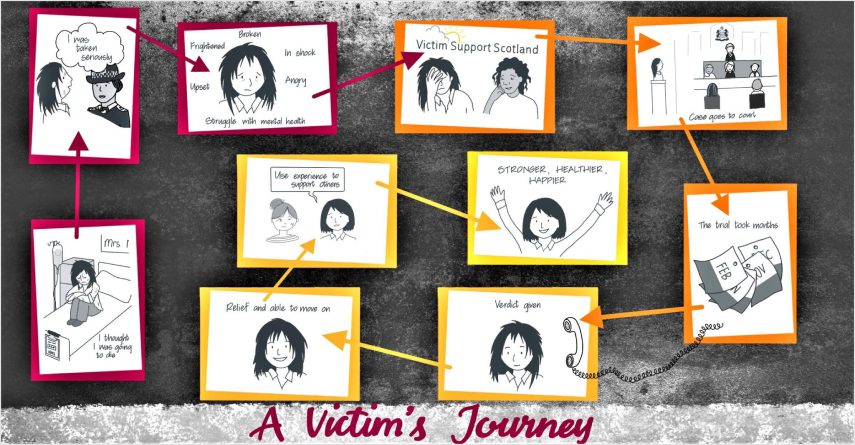
An example of a victim’s journey, adapted from a real story
Steps in image:
- “I thought I was going to die”
- “I was taken seriously”
- Struggle with mental health
- Meet with Victim Support Scotland
- Case goes to court
- The trial took months
- Verdict given
- Relief and able to move on
- Use experience to help others
- Stronger, healthier, happier